
The flexible workspace world has expanded fast and the language has expanded with it.
Hot desks, dedicated desks, private offices, coworking lounges, day passes, virtual offices.
They all promise the same thing on the surface: a professional place to work without a five-year lease. The difference is in the detail, and the wrong choice can cost you anywhere from a few hundred pounds a month to thousands.
This guide breaks down the three workspace types most businesses end up choosing between: hot desk day passes, coworking memberships, and private offices. This means you can pick the one that fits how your team actually works.
What is a hot desk?
A hot desk is exactly what it sounds like: any available desk, on a first-come-first-served basis, in a shared workspace. You turn up, find a free seat, plug in, and crack on.
Hot desking is best understood as a flexible monthly membership or a day pass for something short-term. You're paying for access to the building and its facilities (e.g., Wi-Fi, meeting room credits, coffee and breakout areas) and not a specific square foot of floor.
A hot desk membership tends to suit:
- Solo founders and freelancers who don't need to be at the same desk every day
- Hybrid employees in town one or two days a week
- People escaping the home office for routine, professional surroundings, and other humans
- Anyone testing whether they like a particular building before committing to more space
Hubflow hot desk memberships start from £120 a month in Belfast & £175 a month in London, which is roughly the price of a couple of weekly trips to a nice coffee shop. This, except the Wi-Fi works and nobody asks if you'd like another flat white in a slightly louder voice.
What's the difference between a hot desk and coworking?
Strictly speaking, hot desking is one form of coworking. In practice, "coworking" can also refer to a dedicated desk, both typically in a lounge experience.
Hot desking tends to be more of a flexible approach as opposed to a dedicated desk, allowing you to move around the space more freely.
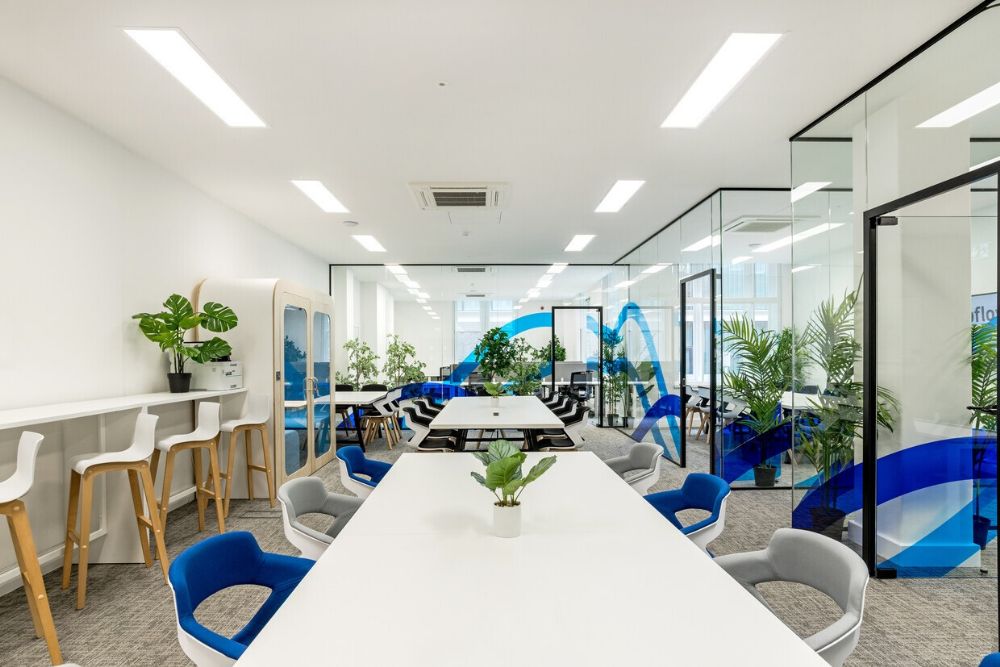
Hubflow's Success Lounge in Central London is a good example of the flexible end of coworking: the variety of flexible memberships, as well as a designed environment built for productive work, client meetings, and the kind of focused mornings that don't happen in a busy café.
Coworking lounges typically suit:
- Founders who meet clients in their workspace and want the surroundings to do some of the talking
- Sales and consulting professionals who need a credible, central setting between meetings
- Small teams of two to four who want a shared base without committing to a private office
If you only need workspace occasionally, a Day Pass gives you the same access for a one-off visit. This is useful for travel days, meetings in town, or trying a building before you commit.
What is a (managed) private office?
A (managed) private office is a lockable, branded space that belongs to your team and only your team.
It's the closest equivalent to a traditional office, except the building, furniture, broadband, cleaning, security, kitchen, meeting rooms, and reception come included.
You're essentially renting an outcome (a working office, ready to go) rather than renting square footage and assembling everything else yourself.
Private offices tend to make sense when you have:
- A team of three or more working together most days
- Confidential conversations incl. client data, hiring, finance, legal
- A need to focus deeply without ambient chat from other companies
- Your own brand, culture, and rituals that benefit from a fixed home
Hubflow's private offices start from £2,400 per month and scale up to suites for larger teams.
Crucially, the all-inclusive model means you're not negotiating separate contracts for cleaning, IT, utilities and furniture etc. It's simply one monthly figure with everything in it.
How to choose between these options?
A useful test: if you can describe your needs in days per week, a hot desk / lounge is probably right. If you describe them in headcount, you're looking at a private office.
Five questions to ask before you sign anything
Pricing pages only tell you part of the story. Before committing to any workspace (Hubflow's or anyone else's), work through these five questions.
1. What's actually included in the price? Some operators advertise low headline rates and bill extra for printing, meeting rooms, after-hours access, even tea and coffee. Ensure that there are no hidden fees included.
2. How does the lease or membership scale? If you hire two people next quarter, can you upgrade without losing your space? If you lose a contract, can you downsize? Genuinely flexible workspaces let you do both within reason.
3. Where does the workspace sit on the day-to-day experience? A great location with bad coffee, slow Wi-Fi or unfriendly reception can drag down your team's productivity. Ask for a tour at a busy time: Tuesday or Wednesday, mid-morning and not a quiet afternoon.
4. What's the meeting room situation? Most flexible workspaces give you meeting room credits, but the rules vary. How many hours per month? Are they bookable last-minute? Can clients use them when you're not there?
5. Who else works there? The community matters more than people expect. If your business is in fintech and the building is full of fintechs, you'll find collaborators, hires, and customers without leaving the floor.
So which one should you choose?
Here's the short version, by stage of business:
- Solo founder, working alone: Start with a hot desk membership or weekly day passes. You'll get most of the benefits at a fraction of the cost.
- Founder meeting clients regularly: A coworking lounge with strong meeting room access. The Success Lounge model is built for exactly this.
- Team of 5 to 10+: A private office, almost always. The maths works once you have three salaries paying for the space.
- Hybrid team, two days in office: A small private office plus hot desk passes for the people who only come in occasionally.
- Distributed team meeting once a month: A virtual office for your address and an event space or meeting room booked for the day.
The good news is you don't have to commit forever. Most teams move between these formats two or three times in their first few years (solo founder to lounge member to private office to bigger private office). A flexible operator should let you do that without penalty.
See the spaces for yourself
The most reliable way to choose between workspace types is to visit a few.
We run private offices, hot desk memberships and day passes across Central London and Belfast. Book a Day Pass at any of our locations and try a workspace before you commit to a single thing.
It's the cheapest piece of office market research you'll do all year.